
The Rescheme is a Real Disruptor
While the format shift looms, NOAA’s ongoing ENC rescheming project is quietly rewriting the rules of data density. By replacing irregular, legacy chart boundaries with a standardized rectangular grid, NOAA is generating thousands of new ENC cells. Crucially, the vast majority of these cells are built at much finer, larger scales than the coverage they replace across usage bands 1 through 5.
Here is what that looks like on the ground: A data pipeline or operational dashboard that queried a fixed Area of Interest (AOI) in 2024 might have pulled 4 to 12 legacy ENC cells. By 2027, that exact same query in the reschemed grid could easily return 30 to 50 cells.
While the geographic footprint remains identical, the cell density has effectively tripled. Downstream consumers—whether they are web-based Common Operational Pictures (COPs), Portal-published feature services, or mobile applications running on watchstander tablets—will immediately feel this change via increased render passes and heavy cache pressure. Teams that ignore the rescheme and focus solely on translating S-57 files to S-101 will inherit degraded cache hit rates and sluggish interactive map performance. The rescheme isn’t a footnote; it’s the primary structural shift you have to design around.
S-101 Introduces an Entirely New Hydrographic Data Model
S-57 is a rigid, flat, binary chart format. S-101, conversely, is a dynamic product specification built on the International Hydrographic Organization’s (IHO) broader S-100 framework. Rather than acting as an isolated chart file, S-101 establishes a model-based approach to hydrographic data designed to plug directly into an ecosystem of complementary specifications, including S-102 (bathymetric surfaces), S-104 (water levels), and S-111 (surface currents).
For a Coast Guard data engineer, this means S-101 cannot be treated as “S-57 with richer metadata.” It introduces an entirely different schema, distinct attribution rules, and entirely new geometry handling for complex features like depth contours and channel margins.
Legacy tools parsing S-57 binary structures directly will break on S-101 data. Hardcoded dependencies on legacy S-57 attribute names will require comprehensive re-mapping. For teams leveraging an Esri environment, ArcGIS for Maritime offers an established migration path, which can be extended to enhance broader mission readiness through modern sensor integration capabilities. However, custom ETL pipelines—especially the brittle scripts frequently used to extract localized features for District-level overlays—cannot simply be ported over. They will require a complete architectural rewrite.
The Parallel Arrival of S-102 Grids
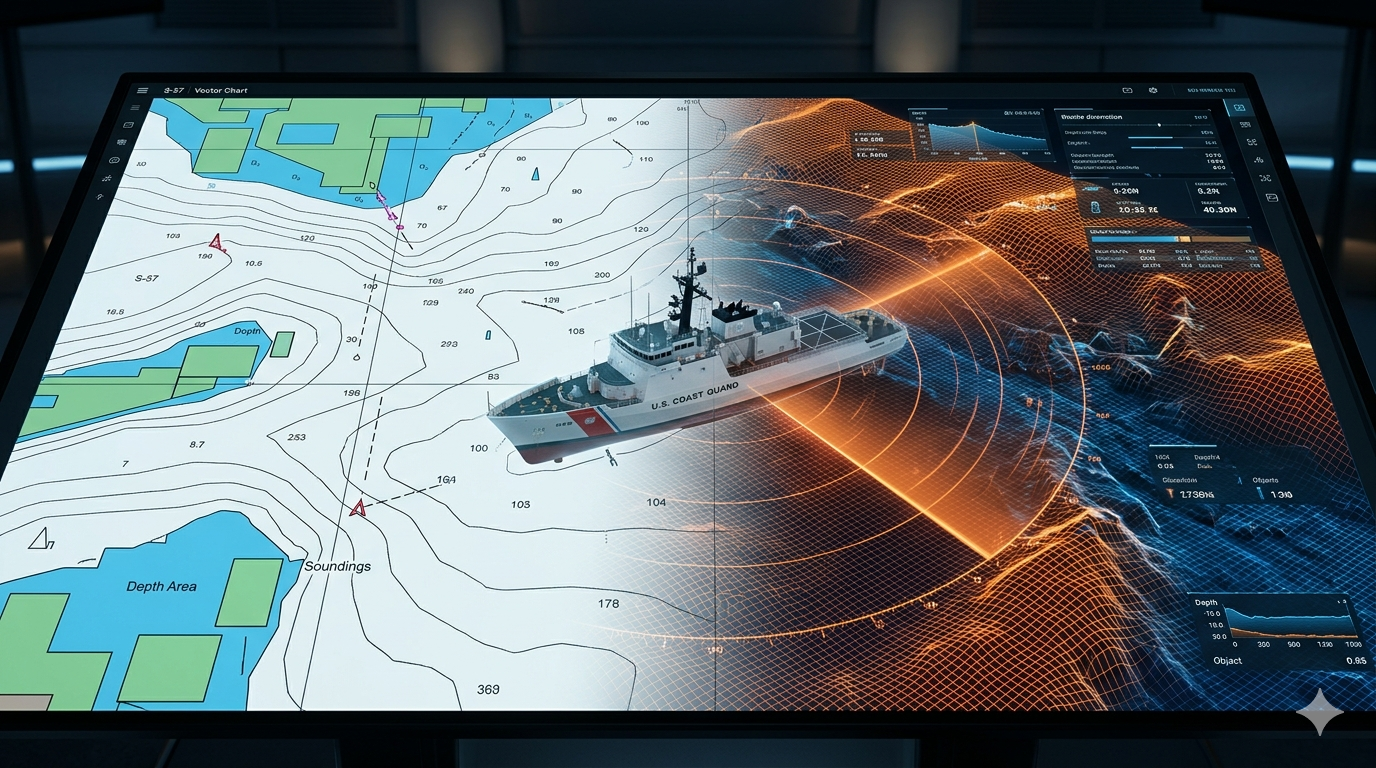
Compounding the S-101 rollout is NOAA’s transition away from large-scale High Definition (HD) ENCs in favor of IHO S-102 Bathymetric Surface data. Unlike the vector-based features of S-101, S-102 delivers high-resolution gridded bathymetric data intended to layer seamlessly within the same Electronic Chart Display and Information System (ECDIS) or geospatial view.
This fundamentally alters how operational questions are answered. If a Coast Guard analyst needs to run a depth-of-water query to verify whether a dynamic Sector waterway is deep enough for an incoming cutter, the workflow changes. It stops being a straightforward vector attribute lookup on a single ENC depth area. Instead, it becomes a federated query blending S-101 chart features with an independent S-102 bathymetric grid.
From an operational standpoint, this is a massive leap forward; the bathymetric data is exponentially denser and updates on a much faster cadence than vector contours can allow. From an IT architecture perspective, however, it adds severe complexity. The query interface must be smart enough to orchestrate requests across two distinct data stores, and the caching strategy must gracefully handle completely disparate tile structures simultaneously.
Action Plan for Esri-Stack Environments
To prepare Coast Guard enterprise GIS environments for the S-101 ENC transition, software architects should prioritize three concrete roadmap adjustments:
- Insulate Ingest Pipelines Early: While NOAA will support a “dual-fuel” window where S-57 and S-101 are published concurrently to allow industry adoption, S-57 production will eventually sunset. Avoid the risk of a rushed, high-pressure pipeline rewrite by designing and testing S-101 ingestion workflows while the S-57 fallback is still active.
- Audit and Re-Test Map Caches: The increased cell density driven by the rescheme makes legacy ArcGIS Server cache settings obsolete. Grid cells that used to sit comfortably at a 1:90,000 scale may now display at 1:22,500. Outdated cache configurations will result in under-pre-rendering at new high-density scales and over-pre-rendering at legacy scales.
- Define the S-102 Storage Architecture: Establish how dense S-102 bathymetric grids will be served out to users. Depending on District query volumes and refresh cycles, they may live best within a dedicated image service, a tiled terrain service, or a custom cloud-optimized raster format. Choosing the wrong storage path early will make future system migrations incredibly expensive.
Winning the Technical Narrative in Government Proposals
For contractors bidding on upcoming USCG federal opportunities, the S-101 ENC transition serves as an immediate technical credibility test.
A proposal responding to a sources-sought or RFP touching maritime situational awareness that simply treats this shift as a routine file update will instantly signal a lack of technical depth. Conversely, a response that explicitly addresses the realities of the rescheme, provides a clear mitigation plan for the S-10 framework’s schema changes, and details an architecture capable of handling parallel S-102 grids demonstrates a partner who is genuinely aligned with NOAA’s operational roadmap.
The Bottom Line: Moving from S-57 to S-101 is a multi-dimensional evolution. It converges a massive grid rescheme, a structural data-model overhaul, and a parallel rollout of gridded bathymetry in 2026. The legacy infrastructure built to handle 2018-era ENC stacks will drop frames and choke on the data density of 2027. Forward-looking teams need to begin refactoring their systems today.
Leave a Reply